TrueMile
Know whether a load actually pays — before you book it.
Open the live app Code on GitHub- automated tests
- 187automated tests
- core screens
- 5core screens
- of signal needed to check a load
- 0 barsof signal needed to check a load
- fallback levels for mileage
- 3fallback levels for mileage
Owner-operators pick loads by the gross rate per mile on the load board. That number hides almost everything that decides whether the truck makes money: the fixed costs that run every day, the fuel burned getting there, the empty miles to the pickup, and the repair bill that is coming whether you plan for it or not.
A load that looks fine at $2.75 a mile can quietly lose money. TrueMile started from one working owner-operator’s real numbers — truck payment, insurance, fuel economy, monthly miles — and turns them into a single honest answer on every load.
Five things, all aimed at one decision.
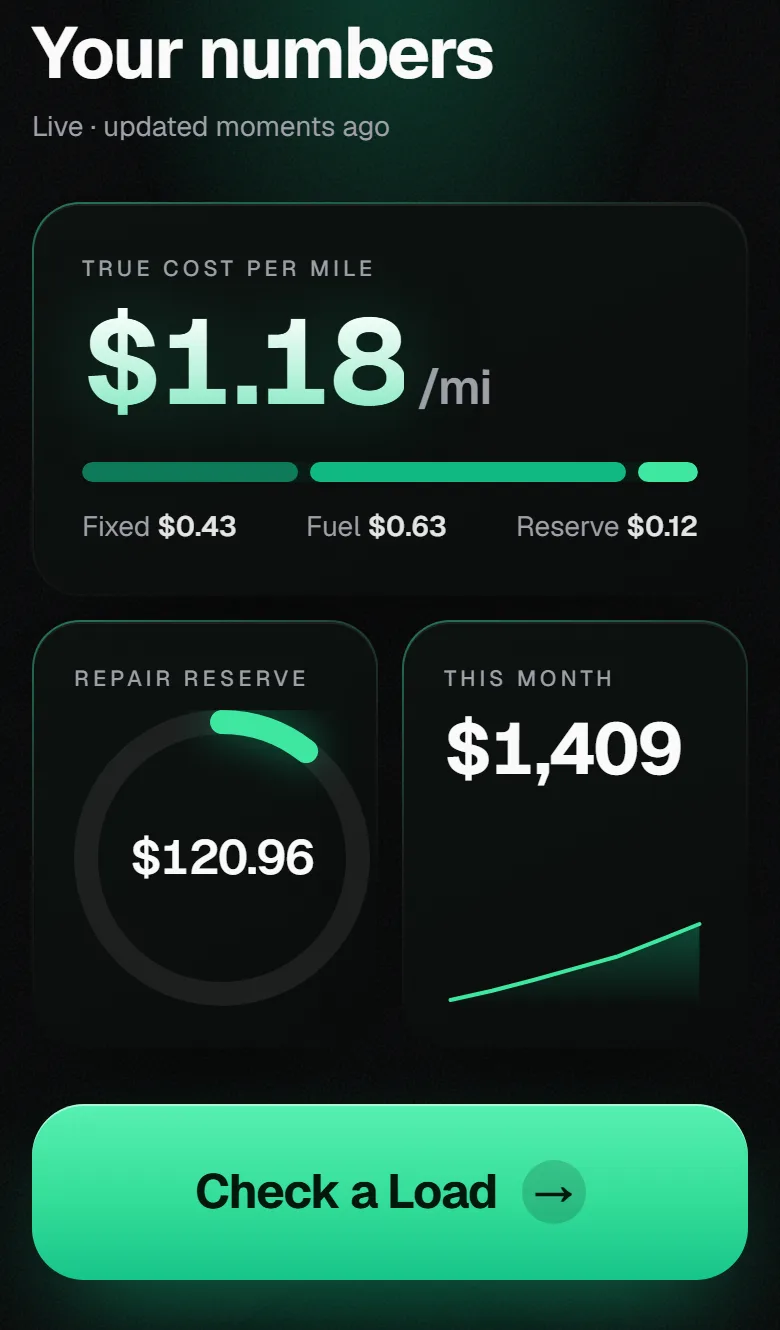
True cost per mile
Fixed costs, fuel and a repair reserve, broken out on one bar so a driver can see where every cent of a mile goes.
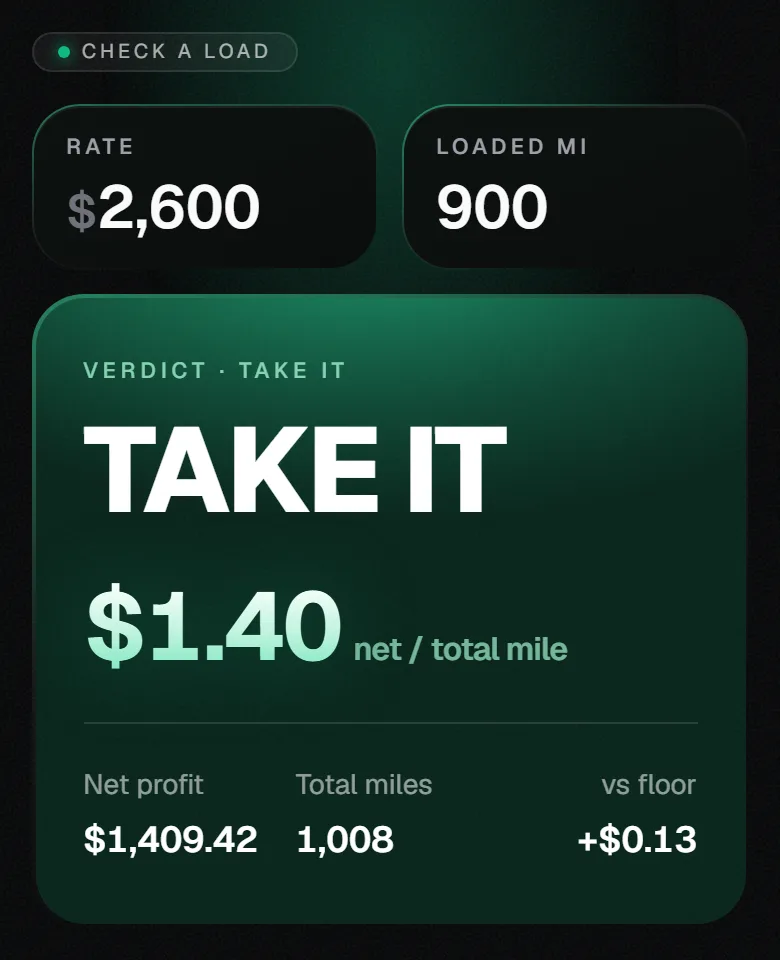
Load Check
Enter the rate and loaded miles; TrueMile adds the expected empty miles, works out net profit per total mile, and returns TAKE IT, THIN — YOUR CALL, or WALK AWAY against the driver’s own floor.
Repair reserve
Each completed load banks a set amount per mile into a reserve, so the next breakdown is already paid for instead of parking the truck.
Works with no signal
Truck stops and rural highways drop coverage. Load Check runs fully offline from cached numbers, and saves queue up and sync when the phone reconnects.
Live fuel and mileage
One tap pulls the current U.S. weekly diesel average from the EIA; pickup and delivery cities fill in the miles automatically.
The decisions that matter, and why.
- 01
A six-digit code to sign in, not a magic link
On a phone, a magic link opens in the browser instead of the installed app, which leaves the driver signed in somewhere they are not. A one-time code keeps the session inside the app.
- 02
The money math is pure functions, pinned by tests
Cost per mile, the empty-mile adjustment and the verdict thresholds live in a layer with no UI or database in it. Tests lock them to a real driver’s numbers — $1.18 a mile, and a $2,600 load over 900 miles coming out at $1.40 net — so a design change can never move a verdict.
- 03
Offline without risking the data
The service worker only ever caches reads. It never touches a save, so an offline session can’t replay or double-write, and the save queue is guarded against a second tap firing the same load twice.
- 04
Each driver sees only their own rows
Row-level security in Postgres enforces ownership in the database itself, not just in the app, so one account can never read another’s loads or costs.
- 05
Every integration fails soft
Mileage tries truck-legal routing, then driving distance, then manual entry, and labels which one it used. With no API key the app still works — it just says it’s an estimate.
TrueMile is usable today at truemileapp.com with working owner-operators on it. Next up: multi-truck support for small fleets, subscription billing, and switching on truck-legal routing — already built, waiting on a routing provider.
Talk about a build like this